|
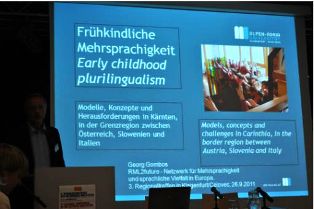
Early multilingualism main topic of the third Regional Conference
Together with Narodni svet koroških Slovencev – the Council of the Carinthian Slovenes – the Network for Multilingualism and Linguistic Diversity, acronym RML2future, will organise its third Regional Conference in Celovec / Klagenfurt, Austria, from 25 – 27 September 2011.
Preschool and school education play an important role for early language learning. At the third Regional Conference on the subject of Early Language Learning the main subject will be to discuss the European aim of multilingualism from early childhood onwards, with regard to minority languages and the bilingualism and multilingualism that is available in multilingual regions by nature.
The experiences and projects with bilingual, trilingual and quadrilingual language teaching in Carinthia, the border region of Austria, Slovenia and Italy offer us the basis for reflection.
We invite you to come to Klagenfurt for the conference and look forward to welcome you!
Dobrodošli! – Welcome! – Herzlich Willkommen!
Narodni svet koroških Slovencev – the Council of the Carinthian Slovenes – was founded in 1949. The Council of the Carinthian Slovenes is an organisation with a Christian orientation. The Council aims at strengthening the identity of the Carinthian Slovenes on the basis of the Austrian constitution and to contribute to a fruitful living together of both ethnic groups in Carinthia.
More information:
Narodni svet koroških Slovencev
Rat der Kärntner Slowenen / Council of the Carinthian Slovenes
Viktringer Ring 26
AT-9020 Celovec / Klagenfurt
Tel: 0043 (0 )463 / 51 25 28
Fax: 0043 463 512528 22
E-Mail: office@nsks.at
Internet: www.nsks.at
|
Fotos |
|
|
|